

Nepal: Initiation into Life in the Kathmandu Valley
- Lauren Smith

- Feb 26, 2022
- 6 min read
Updated: Feb 27, 2022
Namaste from the magical land of Gurkhas, dal baht, and the tallest mountains in the world!

I landed at Tribhuvan International Airport around 9:30am on Sunday after 21 hours of travel time, the trials of which fostered the development of two new friendships. It was on my first 14-hour leg from Chicago to Doha, Qatar, that I met a few friendly Nepali who were quick to take me under their wing on my journey to their mythical home country. I quickly realized that it was not my charming demeanor that inspired such kindness, but simply the demands of Nepali culture, as I have yet to meet a local without a permanent smile and a waiting cup of “welcome tea”. In fact, as a small country who’s mighty mountains have been attracting tourists since tourism began, Nepal could very well be considered the birthplace of hospitality, and the heart of that birthplace would be the nation’s capital: Kathmandu.
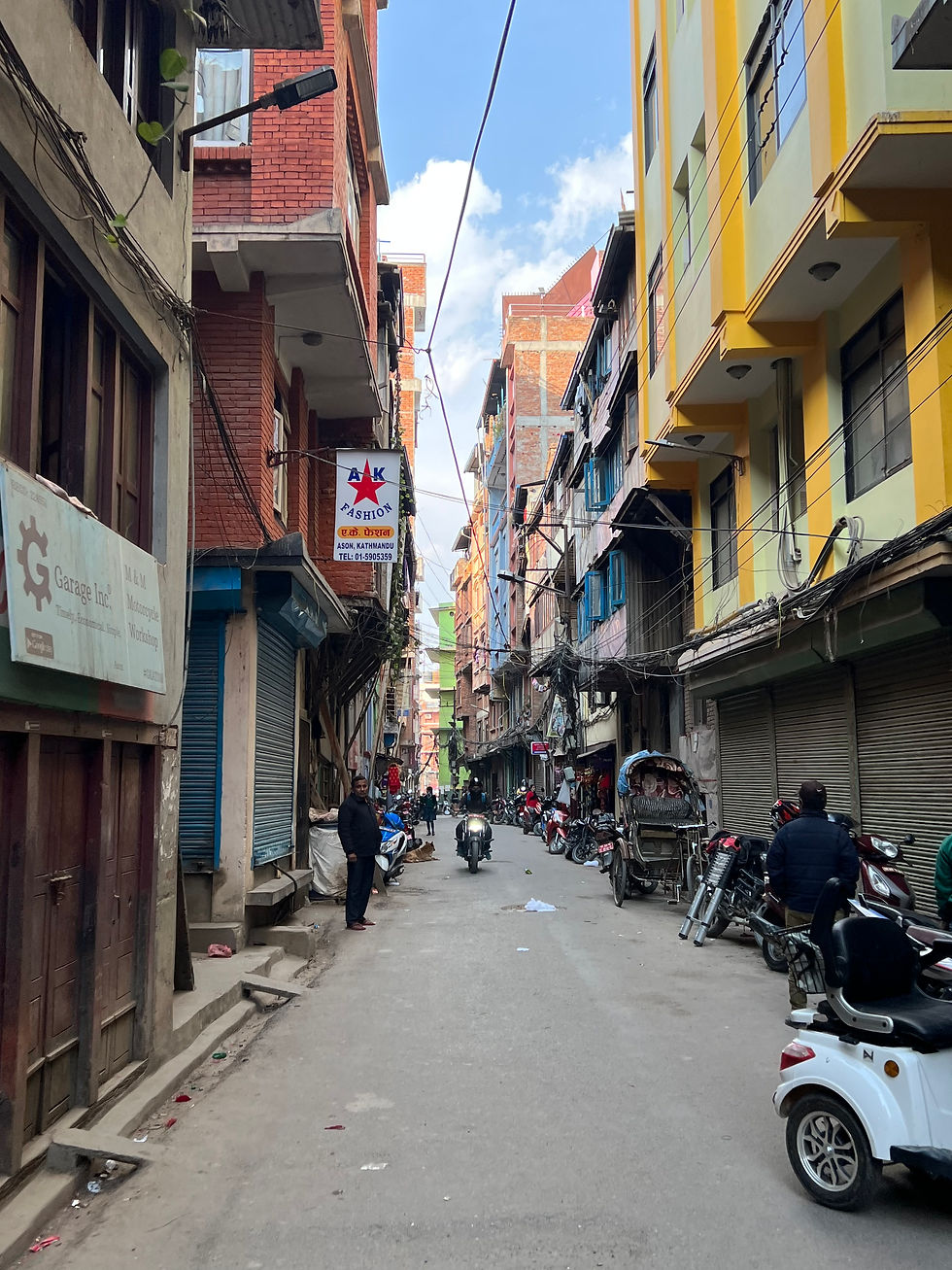
Members of the local Nepali team that had been busy organizing my volunteer stint (Bijen and Shristy) greeted me in the airport lobby with hugs and an excited selfie before tossing my bags in their car. Though it quickly became evident that traffic laws were certainly not a priority in Kathmandu, Bijen showed no fear as he weaved us around motorcycles and pedestrians into the Thamel neighborhood, where I would be staying for my first two nights. Immediately after dropping my bags, Bijen took me on a walk around the bustling hub, once again paying no mind to the crowds of people and vehicles that pushed down the narrow streets. At one point we had to step over the intersection of a motorcycle wheel and car bumper before walking directly into the traffic of a busy intersection just… trusting that they would stop?
Don’t worry, they did.

Needless to say, it was an overstimulating introduction to the city, and, though I tried to keep a brave face, Bijen was laughing at me the whole time. If you found the courage to look up from where you were stepping, you would appreciate the eclectic diversity of Kathmandu, evident in the architecture, cuisine and people. We strolled past ancient temples and worship grounds dedicated to both Hindu and Buddihst faith, as well as building facades that payed tribute to the Indian and Chinese culture that sandwiched Nepal. Local dress ranged from full Sarees and scarves to western shorts and t-shirts, and restaurants covered every cuisine from Jordan to Japan. Considering the impressive linguistic, religious and cultural diversity of this country, it is no wonder the Nepali people are so accepting and accommodating.

My first day on the ground was a fascinating exploration of sound and color that included several stops for tea and a platter of Momo (Nepali dumplings) at a street-side cafe. For dinner, I joined another volunteer at a fourth story, open-air restaurant (everything seems to be open-air, despite the crisp mountain temperatures) for our first meal of dal baht (traditional rice and lentil curry dish). Little did I know that this dish would become incredibly familiar to me, as the Nepali have a saying: “No dal baht today, no sleep tonight”. I have yet to go a day without it.
After a night in what I would come to realize was a relatively luxurious hotel, I spent my first full day in Kathmandu with three other volunteers as we became acquainted with our local team and our placements. Fortified with cups of Himalayan coffee to combat the jet lag, we met for our orientation on the roof of the hotel which overlooked the teeming life of Kathmandu, set against the backdrop of the Himalayan foothills. We then took a trip to visit Swayambhunath, othwise known as the iconic Monkey Temple, nestled high on a hill and wrapped in the beautiful strings of Buddhist prayer flags. The religious Tibetian grounds were also, aptly, teeming with monkeys, to the point where you had to watch your step. The temple offered an even more stunning perspective of both the geography and culture of Kathmandu, and I had to remind myself that I was in fact on the other side of the globe, on the “Roof of the World”, as Nepal has been dubbed. Dinner was (you guessed it) dal baht at a lovely Nepali restaurant, and then we hit our beds early in preparation for the introduction to our home-stays in the morning.


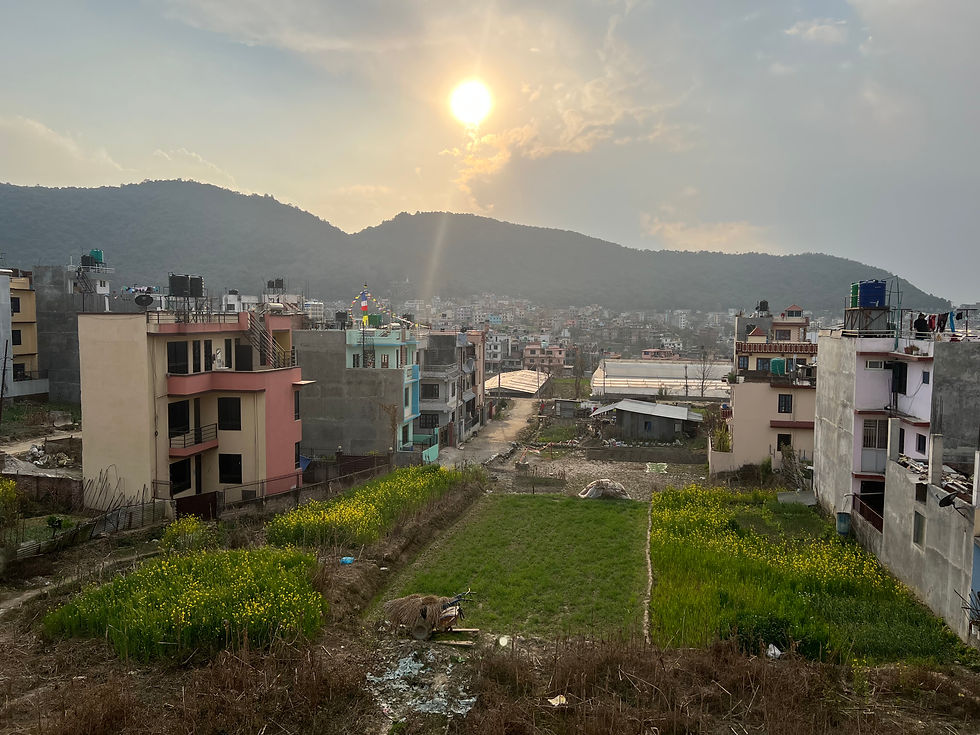
I headed to Bhaktapur on Tuesday, a district just 30 minutes outside of Kathmandu (without traffic lol), accompanied by Sigrid, a fellow volunteer who would be sharing my home-stay. Bhaktapur is the oldest of the three medieval districts of Kathmandu Valley, the other two being Patan and Kathmandu City itself. Bumpy, dusty roads took us through town and dropped us in front of a small community garden, a cow, and the three story structure I would call home for the next five weeks.
Upon arrival, we met the woman of the Sawakoti family, who greeted us with tea (of course) and a welcome scarf. Over a dinner of dal baht, we met the father and two daughters of the family, six and four, who we got to know pretty well by cup of tea #3. The man of the house works on the National Examinations Board of Nepal, and the woman dedicates her time as president of an NGO that provides Nepali women with trade skills that open the door to financial independence. All four members of the family speak good English, much to my relief, though I am making an effort to pick some Nepali as quickly as possible. Our accommodation, very privileged by Nepali standards, could be considered quite rustic by Americans, consisting of a toilet (sans seat), a solar-powered shower, and 2-inch thick mattresses on wooden twin beds. However, I am more than happy to accept the Sawakoti familiy’s hospitality and generosity for the next month while experiencing the heart of life in Nepal.
After four days of volunteer work (I’ll dive into that in another post!) I reached my first Saturday in the valley (the only day of the week considered a “holiday” in Nepal). To take advantage of this time, I toured the Patan Durbar Square and Bhaktapur Durbar Square, (Durbar translating to “Royal”), both of which are considered UNESCO World Heritage Sites. The grand architecture and intricate wooden carvings of the temples couldn’t help but stun, especially considering how much has been restored since the damage of the 2015 earthquake. The care and respect poured into these religious sites is evident in the painstaking upkeep of these ancient structures, all of which boast beautiful statues and elaborate embellishments on each of several stories.

The Patan Durbar Square is especially know for the art and handicrafts featured in the district, while the Bhaktapur Durbar Square boasts impressive architectural style and the origin of Juju Dhau (King Curd), a homemade yogurt served in clay pots around the grounds (It was delicious).

Though it was difficult to keep up with which of the 33 million Hindu gods were being worshiped by each structure, or which idols were dedicated to the Buddhist faith (many of the temples blended the traditions of the two religions), it was a fascinating day of culture and further exposure to life in the Kathmandu valley. The afternoon was finished with a meal of butter chicken, momo, and masala tea at a rooftop restaurant in Bhaktapur Durbar Square, soaking up the last rays of a sunny weekend day. Back at the homestay, I was offered yet another cup of tea by my host mom, which I sipped while throwing stuffed animals at the hyped up little girls who have become my little sisters over the last week. And now I sit here recounting the absolute whirlwind of the past seven days.
The nights have been chilly (due to the cool mountain air and windows that don’t really shut), and the days have been long (due to the inevitable culture shock and 12-hour time change), but I am beyond excited for all I will learn and experience in this beautifully unique country. In fact, I have already compiled a list of lessons I believe no tourist can escape their first week without learning:

• Be wary of black tea unless you are partial to a table spoon of black pepper in your hot water.
• Nepali people will serve you a mountain of food and proceed to offer more and more before you’re even halfway done. Learn to say “no”. No more. Please.
• Milk tea is served in the morning and early afternoon ONLY. Don’t be silly and ask for it at night.
• When visiting a Buddhist Temple, turn the Prayer Wheels CLOCKWISE ONLY for good karma.
• Dress in layers. The weather fluctuates by roughly 35 degrees everyday.
• When in doubt, press your hands together and bow your head. In greeting, in parting, in passing, just do it.
• Don’t trust a Nepali’s estimate of time or distance. 20 minutes? 2 hours? Same difference.
One week down, six more to go!


Comments